
Recently, the Delhi Government and the Central Government have issued a very ‘good’ order. Well, if the government is saying so, there must surely be good and simple rules as well.
“The government has eased the rules for the registration and regularization of properties in unauthorized colonies. Now, registration based solely on a GPA (General Power of Attorney) or a Will will no longer be valid; it has been made mandatory for residents to obtain proper ownership rights (Conveyance Deed) under the Central Government’s PM-UDAY Scheme. Even better, unauthorized colonies are being regularized in their current state without any mandatory layout plan. The compulsion of a layout plan has now been eliminated. Residents can apply by getting a building plan prepared by architects empanelled by the MCD. To make the application process simple and decentralized, the operations of PM-UDAY have been handed over to the Delhi Revenue Department. The land-use of all plots and buildings will now be considered solely as ‘residential’. The final deadline to apply for ownership rights through PM-UDAY has been set for October 31, 2026. Delhi’s 69 ‘affluent’ (posh) unauthorized colonies (such as Sainik Farms, Mahendru Enclave, Anantram Dairy, etc.) have been completely excluded from this ‘relief’. There is a complete ban on granting ownership rights to properties falling within the Yamuna Khadar (Zone-O), notified or reserved forest areas, ASI (Archaeological Survey of India) protected historical sites, under high-tension wires, and in the Ridge Area. According to the rule, only those colonies and properties are considered eligible which existed by June 1, 2014, and where at least 50% construction (built-up area) had been completed by January 1, 2015. The Honorable Supreme Court has given several ‘historic’ and ‘strict’ judgments regarding unauthorized colonies in Delhi and the buying and selling of properties based on GPA (General Power of Attorney)/Will/Sale Agreement, and has refused to consider them as a valid basis for property ownership.”
The government has regularized many colonies in phases before this as well. And why shouldn’t it, after all, it is the government of a democratic welfare state. If the government doesn’t take care of Delhi’s population of nearly 15 million, who will? If the courts do not understand their pain, who will?
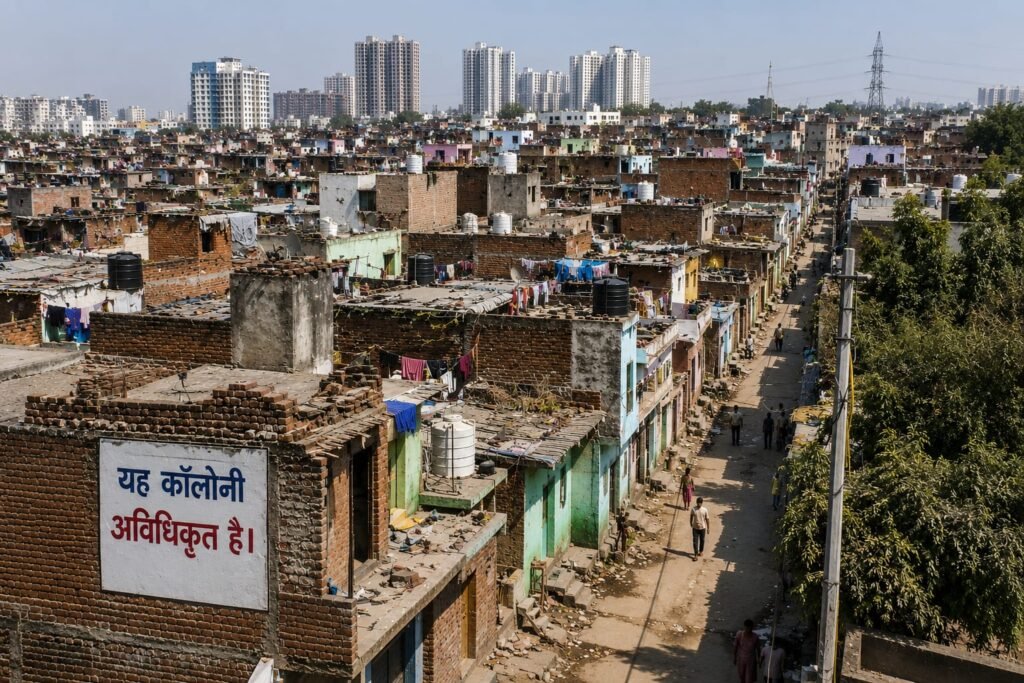
But tell me honestly, did you understand these ‘simple’, ‘easy’, and ‘convenient’ provisions? The government decided the fate of so many people’s entire lives through just one administrative order. What will be the rules for taxes? Is there any policy or law for this? What happened to the previous rules and orders? The government had issued some orders in 2002 as well, what happened to them? What will be done to inform people about this entire process? There are dozens of such questions.
An even bigger point is, who are these people who invest their entire life savings to buy a roof over their heads but do not get proper, official documents made for it? In reality, these colonies are ‘unauthorized’ in official government records. How can the government officially ‘register’ an ‘unauthorized property’? Therefore, buying and selling started happening there through GPA. Along with the GPA, they create a set of multiple documents including a Will, agreement to sell, possession letter, and receipts. Now, since the actual registration of the land cannot take place, people who want extra security get this set of documents registered. But the government and the courts constantly state that these are not documents of ownership—meaning if you have bought a property through these documents, you are not its legal owner.
These ‘unauthorized colonies’ did not appear overnight. Many governments came and went, many officials came and went, but no one stopped them because many benefited from them. These residents also knew that they held so much voting power that they could not be removed later. Then, on humanitarian grounds, governments give them everything—roads, electricity, water, Aadhaar cards, voter ID cards, ration cards, etc. Maps are drawn so that Legislative Assembly and Lok Sabha seats are created. From the voter cards made on the addresses of these unauthorized houses of unauthorized people living in unauthorized colonies, Members of Parliament, MLAs, and Councillors are elected—who become authorized, but these residents remain unauthorized.
The government and the courts say they are not the owners of their houses; they are not tenants either, nor are they trespassers because they pay the bills for electricity and water for that very house, they pay taxes; they are not infiltrators because they vote. So then, in their own country, in their own city, in their own homes, who are these unauthorized people? Under which category does the law or the government place them?
Did you make any sense of this ‘authorized-unauthorized’ dilemma? Well, I would just say, “Yes sir, Government/court, whatever you are saying, whatever you are doing, must be right. After all, you are our government.”